
July 30, 2026
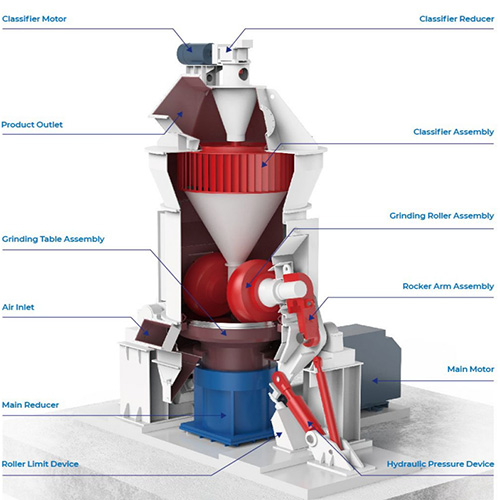
Overall Appearance Drawing of Kaolin Vertical Roller Mill
Kaolin is one of the most widely used industrial minerals, and vertical roller mills (VRM) have become core processing equipment for kaolin. Integrating grinding, classification, drying and conveying in a single unit, they stand as the top choice for kaolin manufacturers. So what specific technical parameters does a vertical roller mill for kaolin processing feature, and why do these parameters matter? This article breaks down all key specifications in detail to clarify the critical factors for your equipment selection.
Why Should You Pay Attention to Technical Parameters for Kaolin Grinding?
The value of kaolin directly depends on its particle size, whiteness and purity. The grinding process must achieve precise fineness, generally ranging from 325 mesh (45 μm) to 2500 mesh (5 μm), to meet the standards of downstream industries such as paper coatings, ceramics, paints, plastics and cosmetics. Vertical roller mills can produce ultra-fine powder with uniform particles and narrow size distribution, making them the preferred grinding technology.
Key Technical Parameters of Kaolin Vertical Roller Mill
1. Grinding Disc Grinding
The millstone diameter directly determines the mill’s production capacity. A larger diameter allows higher material throughput and output.
| Model Series | Grinding Disc Grinding (mm) | Capacity(t/h) |
| HVM1400 | 1400mm | 3–14 (Depends on target fineness) |
| HVM1600 | 1600mm | 5-17 |
| HVM1700 | 1700mm | 6-19 |
Data of HVM series based on calcite test; output varies with target fineness.
For large-scale production demands, the HVM2400 model features a 2400 mm millstone diameter with a capacity up to 40 t/h, fully meeting the requirements of mass industrial production.
2. Number of Grinding Rollers
Grinding rollers exert compressive force on the material bed atop the rotating millstone. The quantity of grinding rollers directly impacts grinding efficiency and operational stability.
HVM Series: Equipped with 2 to 3 grinding rollers as standard.
More rollers generally deliver stronger grinding pressure and higher output of fine powder, yet the exact number is determined by the overall mill design.
3. Fineness Range of Finished Powder
Fineness is the most critical indicator for kaolin grinding. Modern vertical roller mills equipped with high-efficiency dynamic classifiers enable precise particle size control, with adjustable fineness without machine shutdown.
Typical fineness range: 300–3000 mesh (47–5 μm).
Ultra-fine grinding capacity: Fitted with a secondary classification system, certain mill models can reach a fineness of 3 μm (D97).
Precise classification: The integrated classifier guarantees narrow particle size distribution, which is essential for high-standard applications such as paper coatings.
4. Feed Particle Size and Moisture Handling Capacity
These two parameters define the basic raw material requirements for the mill. Maximum feed particle size: For the HVM series, the standard feed size is less than 10 mm or up to 20 mm. Certain models fitted with a pre-crushing system are capable of processing materials with a particle size no greater than 50 mm.
Raw material moisture: Most vertical mills are equipped with a hot air system, enabling them to process feedstock with a moisture content of 3% to 5% without external drying equipment. Special customized designs can handle raw materials with moisture levels as high as 15% in a single pass.
This built-in drying performance constitutes a prominent advantage. It eliminates the need for standalone drying units and streamlines the overall production process.
5. Metal Wear and Product Purity
Kaolin purity is critical, especially for high-end application scenarios. HVM Vertical mills are engineered to minimize metallic contamination generated during the grinding process.
Metal wear rate: As low as 5–10 grams per ton of processed material.
Wear-resistant materials: The grinding rollers and grinding table liners are fabricated from special wear-resistant alloys to extend service life and cut down contamination.
Reduced wear brings higher product purity alongside lower maintenance costs, serving as a core selling point for customers targeting high-end markets.
6. Energy Efficiency
Power consumption accounts for a major share of operational costs. Vertical mills deliver remarkable power savings in comparison with conventional ball mills.
Power saving performance: Energy consumption is reduced by 30%–40% versus ball mills.
Integrated process merits: Integrating grinding, drying and classification into one unit removes the requirement for multiple standalone machines. The overall plant energy consumption can be lowered by 30%–50% comprehensively.
Whether your target markets are paper coatings or high-performance industrial fillers, selecting a vertical mill with matched parameters is critical to your market competitiveness. If you require accurate recommendations tailored to your specific raw material properties and production capacity targets, please consult the technical team of the equipment manufacturer.
Have any further questions regarding vertical mill model selection? Feel free to get in touch with our technical team for a customized evaluation solution.