Look at the corner of an elevator door, a building cladding panel, or a good equipment enclosure. The edge is sharp — almost like folded paper. Plain bending doesn’t do that. Press a sheet into a die without preparation and you get a generous radius, springback fighting you the whole way, and on harder or thicker stock, cracks along the outside of the bend.
Sharp corners come from somewhere. They come from a groove cut before the bend ever happens.
Why the groove works
V-grooving machines a narrow V-channel exactly along the future bend line, thinning the material where the fold will be. With less material resisting at the corner, the sheet folds to a tight radius with far less force and far less springback. The outside surface — the face everyone sees on decorative stainless work — stays smooth: no die marks from heavy tonnage, no orange-peel stretching, no cracked coating.
That is why grooving sits upstream of so many visible products. Elevator doors and cabin panels, architectural cladding and curtain walls, signage, commercial kitchen equipment, high-end enclosures — anywhere the corner is part of the design, the groove is what makes it possible. The press brake still makes the bend. The groover decides what the bend looks like.
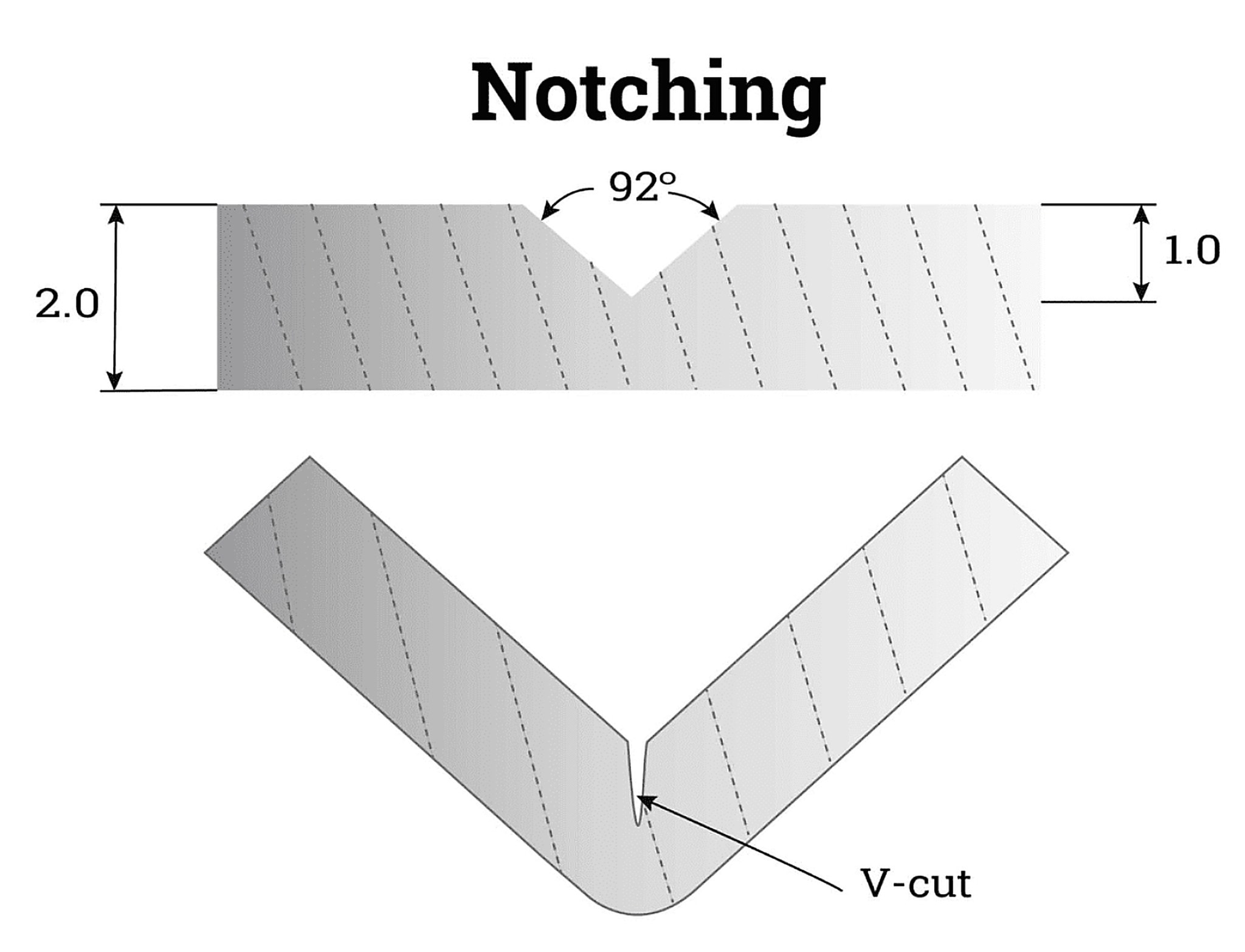
Grooved vs. plain bending: the V-groove is what lets a sheet fold to a sharp, clean corner.
Why big panels are grooved lying flat
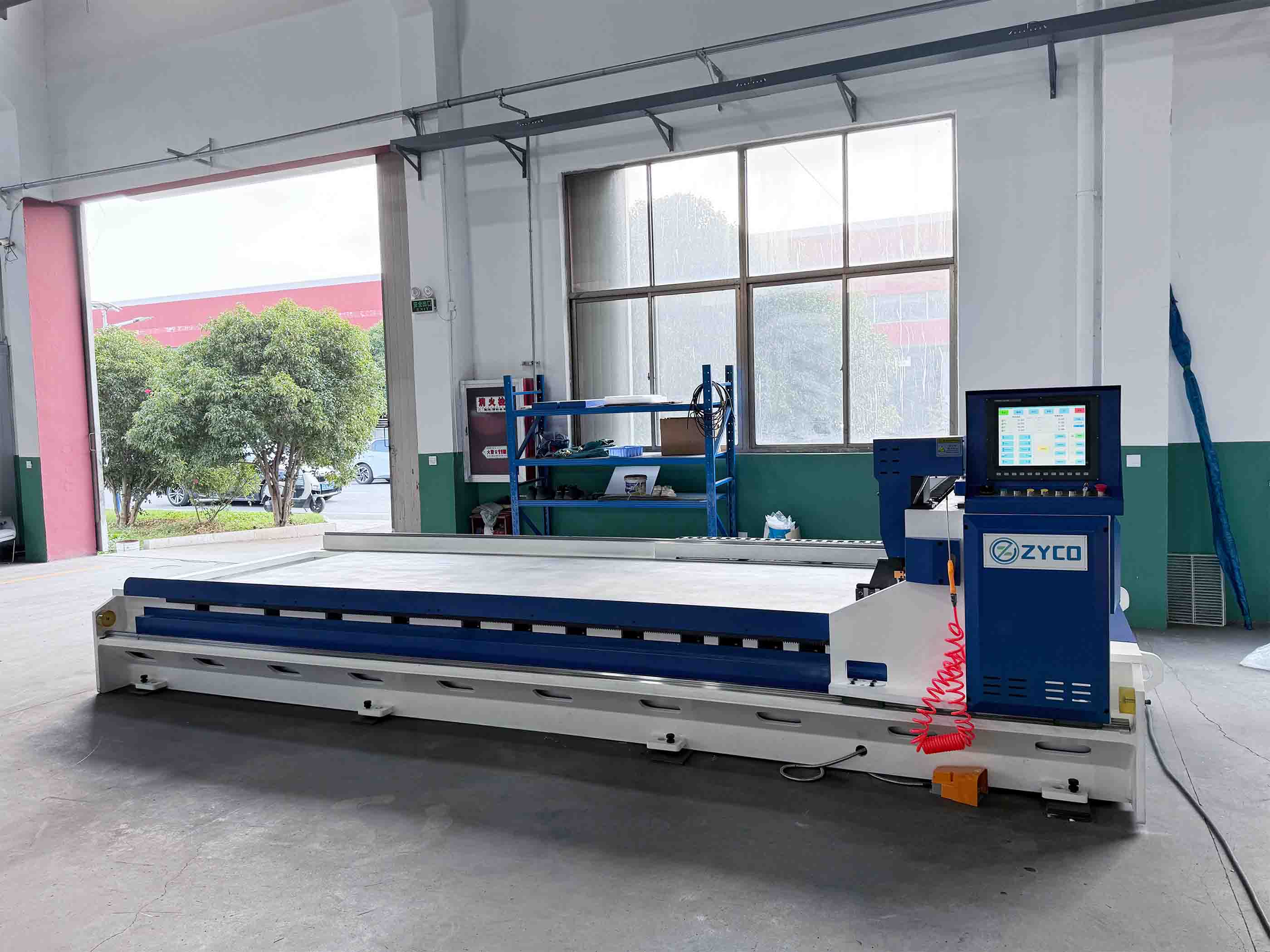
There are two ways to hold a sheet while you groove it. On a vertical machine, the sheet stands upright. On a gantry machine, it lies flat on a table — clamped, fully supported along its whole area — while a moving gantry carries the cutting head along the groove line.
For large work, flat wins for simple physical reasons. A four-meter panel standing on edge can sag, flutter, and spring under its own weight; lying on a table, it can’t.
Support everywhere means the distance from sheet surface to cutter stays constant, so groove depth holds even from one end of a long panel to the other. Loading is easier, too — big sheets arrive by crane or forklift and land flat, instead of being wrestled upright. If your work is long architectural panels, the gantry layout isn’t a preference. It’s how size stops fighting precision.
Running a gantry groover well
Flat doesn’t mean forgiving. Three things decide whether a long groove comes out clean.
Flatness first. The table supports the sheet; it cannot straighten it. A warped panel lifts and rocks between clamps, and groove depth follows the warp — shallow here, deep there. Check the sheet before blaming the machine.
Clamp the whole length. Cutting forces try to walk the sheet sideways for the entire pass. One loose zone is enough for the panel to creep mid-cut, and the groove wanders with it. Clamping pressure should match the material: firm enough to hold a long pass, gentle enough not to mark thin decorative faces.
Respect the chips. A long cut produces a long trail of chips, and they migrate — under the sheet, into the cut path, onto the guides the gantry rides on. Chips under the panel lift it by exactly their thickness, and your depth goes with them. Chip removal on these machines isn’t housekeeping. It’s part of the accuracy system, and it has to run, not just be fitted.
Reading the groove
A finished groove reports on the whole setup, if you read it in the right places. Burrs and rough edges — especially toward the far end of a long panel — are the tool’s report card: a knife that cuts cleanly at meter one and tears at meter four is telling you it’s worn, or that feed and speed are asking too much of it. Grooves are cheapest to judge before the panel reaches the press brake.
When depth drifts along a groove, work in a fixed order: sheet flatness, clamping, tool condition, then the machine’s depth axis and guides. Most shops reach for the machine first and the material last. On long panels, it’s usually the other way around.
Care, measured in meters
Maintaining a gantry groover means maintaining accuracy over distance. The long linear guides and ball screws that carry the gantry need to be kept clean and lubricated along their full travel — a dry or dirty section in the middle of the bed becomes a depth error in the middle of every panel. Clamping cylinders and seals deserve scheduled checks, because holding force is a quality parameter, not just a function. And calibration should be verified along the full working length, not only near the home position: a machine can be honest at one end of the table and quietly off at the other.
None of this is complicated. It’s the same lesson as every precision machine: the process decides the part, and the routine decides the process.
Sharp corners don’t come from the bend. They come from a groove, cut flat, cut clean, and cut the same at meter four as at meter one.
Frequently Asked Questions
What is a gantry V grooving machine?
A gantry V grooving machine is a CNC machine that cuts a precise V-shaped groove along the bend line of a metal sheet while the sheet lies flat on a worktable. A moving gantry carries the cutting head along the panel. It is designed for large-format sheets — architectural cladding, elevator panels, signage — where the sheet is too big to
handle upright.
Why V-groove sheet metal before bending?
V-grooving thins the material exactly at the bend line, so the sheet folds to a much smaller inside radius with less tonnage and less springback. The visible face of the panel stays smooth and unmarked, which is why grooving is standard practice for decorative stainless steel work that needs sharp, clean corners.
What is the difference between a gantry (horizontal) and a vertical V grooving machine?
On a vertical grooving machine the sheet stands upright and the cutting head travels along it; on a gantry machine the sheet lies flat on a table and the gantry travels. Vertical machines suit smaller, thicker parts and take less floor space. Gantry machines handle larger, thinner panels better, because the sheet is fully supported and cannot sag or vibrate during the cut.
Which materials and products is gantry V-grooving used for?
It is used mainly on stainless steel, aluminum, and coated sheet for products where corners are visible: elevator doors and cabins, building cladding and curtain walls, signage and display work, commercial kitchen equipment, and premium enclosures.
What causes inconsistent groove depth on a long panel?
Work through four causes in order: a sheet that isn’t flat, clamping that lets the panel creep during the pass, a worn cutting tool, and finally the machine’s depth axis or guides. On long panels the cause is usually the sheet or the clamping — not the machine.
How do you maintain a gantry V grooving machine?
Keep the long linear guides and ball screws clean and lubricated along their full travel, keep the chip removal system running and cleared, check clamping cylinders and seals on schedule, inspect the cutting tool before every job, and verify calibration along the full working length — not just near the home position.
Can a V-grooved sheet still be bent on a standard press brake?
Yes. Grooving is a preparation step, not a replacement for bending. The grooved panel goes to a standard press brake and folds along the groove at a lower tonnage than an ungrooved sheet of the same thickness would need.
Talk to ZYCO’s engineers about V-grooving setup for large panels — machine layout, clamping, and process parameters for the work you’re quoting.