Quick Answer
Key Takeaways
- The valve distributes the pump's single flow to every function and sets the priority between them.
- The spool is the working part: precision machining is what produces balanced flow and smooth compound actions.
- The valve also manages pressure — main relief and port reliefs live here.
- One or two weak functions points at the valve; weakness across every function points upstream at the pump.
- An optimised internal oil circuit means less pressure loss, less heat and better fuel efficiency.
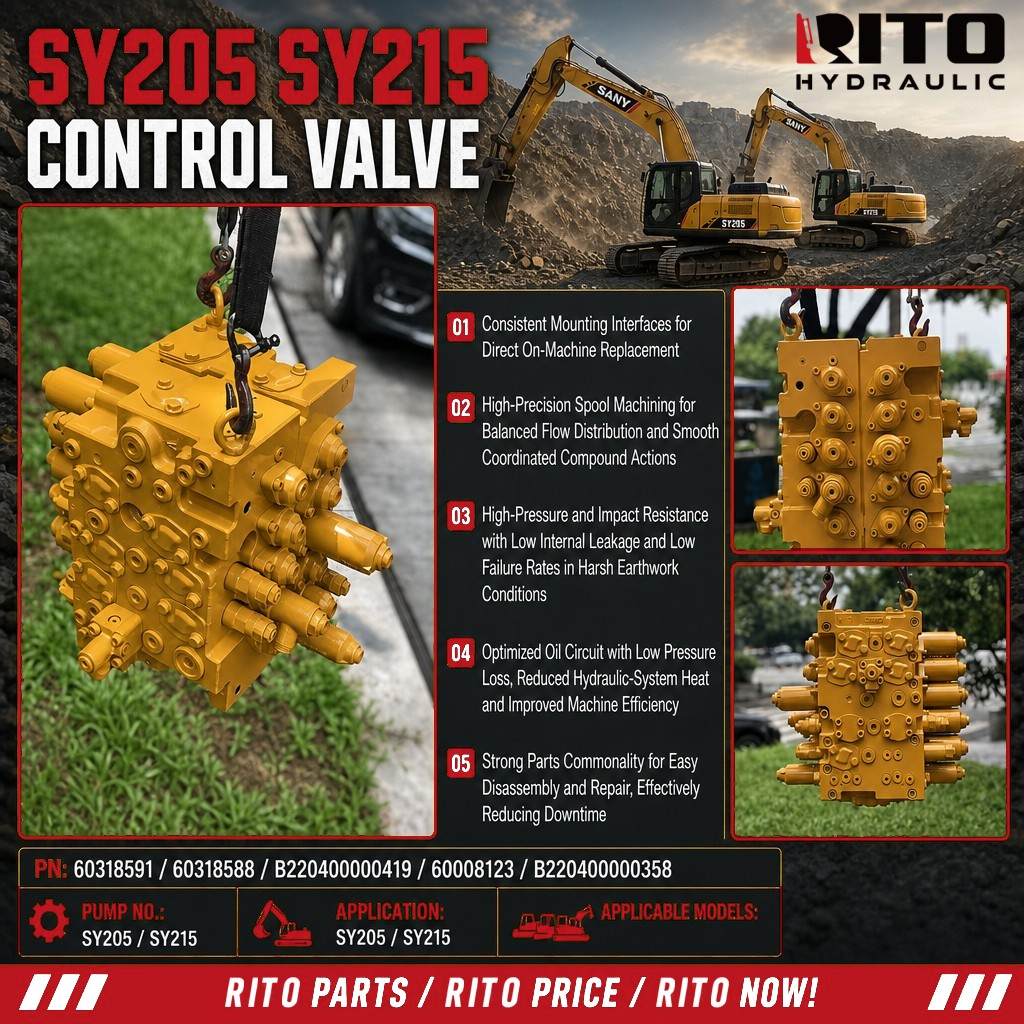
- The unit is ordered under SANY numbers 60318591 / 60318588 / B220400000419 / 60008123 / B220400000358 for the SY205 / SY215.
Table of Contents
- 1. What the Main Control Valve Actually Does
- 2. Follow the Oil: the Valve Section by Section
- 3. The Spool: Where the Work Happens
- 4. How the Valve and Pump Talk to Each Other
- 5. Pressure, Loss and Heat
- 6. How These Valves Fail — and What You Notice First
- 7. Identifying the Right Valve
- 8. FAQ
- 9. Get Your Valve Confirmed
1. What the Main Control Valve Actually Does
On a 20-tonne machine like the SY205 or SY215, one main pump supplies everything. It cannot supply every function at full flow at the same time, and it has no idea which one the operator wants. The main control valve solves both problems at once. It does three jobs:
| Job | What it means in practice |
|---|---|
| Distribution | Sends oil to the function the operator selected, and shares it between functions when more than one is used |
| Priority | Decides who gets flow first when the operator asks for two or three movements at once |
| Pressure control | Limits system pressure at the main relief and protects individual circuits at the port reliefs |
It also performs a fourth job that is easy to overlook until it goes wrong: it tells the pump how much oil the machine needs. Without that conversation, the pump would deliver a fixed flow and the surplus would simply become heat.
That is why the valve earns its reputation as the component that "feels like" everything else. A fault here can imitate a pump problem, a cylinder problem or an operator complaint about the machine being "lazy". The complete range of assemblies is grouped under control valve assemblies.
2. Follow the Oil: the Valve Section by Section
The clearest way to understand a control valve is to follow one drop of oil through it. On a valve of this type, the flow passes through a sequence of sections, and each has a specific job:
| Stage | What happens | Why it matters |
|---|---|---|
| Inlet section | Oil arrives from the pump; the main relief valve caps system pressure here | Protects every component downstream from overpressure |
| Function sections | One section per function — boom, arm, bucket, swing, travel — each with its own spool | A fault here affects that function only, which is a powerful diagnostic clue |
| Port reliefs | Individual pressure limits on selected circuits | Stop a single circuit from being overloaded — and they can also stick or drift out of setting |
| Return passage | Oil leaving the actuators travels back through the valve to the tank and cooler | Restriction here shows up as back pressure, heat and sluggish return movements |
Notice what that structure implies: the valve is a collection of independent circuits sharing one body. This is the single most useful thing to know when a machine misbehaves, because it converts a vague complaint into a location. One function behaving badly narrows the search to one section. Everything behaving badly points away from the valve and towards the pump or the control system.
3. The Spool: Where the Work Happens
Inside each section sits a spool — a precision-ground steel shaft that slides in a matched bore. Moving the lever moves the spool; the spool's position uncovers or closes passages, and that is what meters the oil.
Two consequences follow from this, and they explain most of what you feel on the machine:
- Flow is metered by position, not by switching. A spool does not simply open a gate — it opens progressively, so the operator can feather a function. That is why a worn or sticking spool feels jerky, grabby or hard to control, even when the machine still has full power.
- Clearances are measured in microns. The spool-to-bore fit is what keeps oil going to the actuator instead of leaking past the land. Fine clearances are exactly what makes the valve precise — and exactly what makes it vulnerable to contamination.
High-precision spool machining is therefore not a marketing phrase; it is the difference between a valve that distributes flow in balance and one that starves one function while overfeeding another. It is also what makes compound actions — boom, arm and bucket moving together — feel coordinated rather than hesitant. If two functions must share one flow, the geometry of the spools and passages decides how fairly that flow is divided.
This is also why these valves are described as pressure- and impact-resistant with low internal leakage: a valve that holds pressure and does not leak past its spools keeps the machine's full digging force available, and keeps working in harsh earthmoving conditions without drifting or weakening.
4. How the Valve and Pump Talk to Each Other
The pump cannot see the levers, so the valve has to tell it what is happening. In practice, the valve passes a signal back to the pump — under no load and no demand, the pump is asked for very little; as functions are opened and loads rise, it is asked for more.
The exact way that signal is generated differs between machines and generations; depending on the system, it can be a pressure signal from the valve, a negative-control signal when functions are centred, or an electronically controlled command. What matters for a buyer or an operator is the principle: the pump's output is a response to the valve, not a fixed quantity.
That principle explains a common and expensive misdiagnosis. If a machine is slow in every function, the fault is not automatically "the pump" — it may be the signal never reaching the pump, or the valve not generating it. The two have to be tested together. The system-level view of that relationship is set out in our guide to the control valve on the Komatsu PC300-8 and what CLSS means — the same logic applies here, only the markings differ.
5. Pressure, Loss and Heat
Here is a fact worth more than it looks: every unit of pressure the oil loses inside the valve without doing work becomes heat. Nothing else. Not friction, not wear — heat, which then has to be removed by the cooler and which shortens the life of every seal and every oil charge in the system.
That is why an optimised internal oil circuit matters economically rather than theoretically. Short, generously sized internal passages with low resistance mean:
| Because of low pressure loss | You observe |
|---|---|
| Less energy converted to heat | Lower, more stable oil temperature; seals and oil last longer |
| More of the pump's output reaching the actuators | Faster, stronger functions for the same engine effort — better fuel efficiency |
| Less restriction on the return path | Smoother, more predictable movements rather than a machine that feels held back |
This is also the honest answer to a question owners ask constantly — "why does my machine run hot?" On a valve that has been rebuilt with poor attention to internal clearances, restricted passages or a mis-set relief, the heat is manufactured inside the valve. The same is true in reverse: a valve with correct relief settings and a clean internal circuit keeps oil temperature down without any change to the cooler.
6. How These Valves Fail — and What You Notice First
Control valves rarely fail in a single dramatic moment. They wear, and the wear announces itself as a change in how the machine behaves. These are the modes worth knowing, with the symptom each one produces:
| Failure mode | What you notice first |
|---|---|
| Contamination scoring the spools and bores | One or two functions become weak, jerky or slow; often follows a pump failure or a filter neglect |
| Internal leakage past worn lands | Functions drift or creep when held; the machine slowly loses holding power under load |
| Sticking spool | A function that grabs, jumps, or fails to return to neutral — a safety issue, not just an annoyance |
| Relief drift or a sticking relief | Loss of power on a specific circuit, or heat and noise when a function stalls |
| Seal and O-ring deterioration | External weeping, and pressure loss between sections |
The most important line in that table is the first one, because it is the one an owner can prevent. Contamination is the primary killer of control valves, and it usually arrives from somewhere else in the circuit — a failing pump shedding metal, a neglected filter, or a hose changed without cleanliness. On a machine with a valve of this class, if a pump has failed, the valve should be inspected at the same time; replacing a pump into a contaminated system simply moves the problem downstream.
The diagnostic rule, repeated because it is worth money: one or two weak functions points at the valve section; weakness across all functions points upstream at the pump or the control signal. The same symptom-first reasoning applies to the travel side of these machines, which is worked through in our guide to travelling slowly on one side.
And when the decision is replacement, the internal design details are what separate a lasting valve from a short-lived one: consistent mounting interfaces so the unit goes straight back on the machine, spool machining and clearances that hold pressure, and parts commonality so the unit can be dismantled and serviced without a special order for every internal piece. That last point matters more than it sounds — commonality is what turns a valve failure from a long downtime event into a manageable repair.
7. Identifying the Right Valve
The main control valve assembly for the SY205 / SY215 is ordered under the following SANY numbers:
| SANY number |
|---|
| 60318591 |
| 60318588 |
| B220400000419 |
| 60008123 |
| B220400000358 |
Two things to watch when matching these numbers.
First, the same number is written in more than one form. SANY "B" numbers carry twelve digits after the letter, so B220400000419 is the complete form; you will also see it printed with fewer zeros in some listings and on some documentation. Match the number as a whole rather than expecting the string to look identical everywhere.
Second, a number shared across SY205 and SY215 does not mean every valve fits both. The machine family shares a valve platform, but the fitted unit still depends on the build and serial number, and on the section configuration the machine was assembled with. Read the plate on your own valve, record the full number, and confirm against the machine's serial before ordering. The same "read the plate first" discipline is set out for the larger machine in our guide to the SANY SY365 / SY485 / SY500 control valve, where the plate carries several identifiers that all matter.
Replacement assemblies and the wider spare range are grouped under excavator hydraulic parts.
8. FAQ
Q1: What does the main control valve do on a SANY SY205 or SY215?
It takes the single flow from the main pump and distributes it to the function the operator selects, sets the priority between functions used together, and limits pressure through the main relief and port reliefs. It also signals the pump how much output the machine needs.
Q2: How does the valve actually control flow?
Through spools. Each function has its own spool sliding in a matched bore; moving the lever moves the spool and progressively uncovers passages, metering oil to that function. The precision of the spool-to-bore fit is what keeps flow balanced and lets the operator feather a movement smoothly.
Q3: What is the part number for the SY205 / SY215 control valve?
The assembly is listed under SANY numbers 60318591, 60318588, B220400000419, 60008123 and B220400000358. Confirm the correct one from the plate on your own valve together with the machine serial number.
Q4: Why are there five part numbers for one valve?
Because the machine family was built in more than one configuration and the numbers were revised over time. They are related references for the same valve platform rather than five interchangeable goods — which is exactly why the plate and serial decide the order.
Q5: One function on my machine is weak. Is that the valve?
It is the most likely place to look. Because each function has its own section, a fault affecting only one or two functions usually sits in that section rather than in the pump. Weakness across every function points upstream instead, to the pump or the control system.
Q6: Why does the valve cause the machine to run hot?
Because pressure lost inside the valve without doing useful work becomes heat. If internal passages are restricted, clearances are wrong or a relief is mis-set, the valve manufactures that heat — which then has to be removed by the cooler, shortening the life of the oil and the seals.
Q7: What is the most common cause of control valve failure?
Contamination. Grit and metal that arrive from another part of the circuit — often a failing pump or a neglected filter — score the spools and bores and open up internal leakage. It is also the most preventable cause.
Q8: My machine drifts when I hold a function. Why?
Drift usually means oil is leaking past a worn spool land inside that section, or past the cylinder's own seals. A pressure test on the affected circuit separates the two before you buy anything.
Q9: Can the valve be repaired instead of replaced?
Sometimes — where the fault is confined to seals, a relief setting or a serviceable section, and the body and bores are undamaged. Scoring, body damage or faults in several sections make replacement the sensible route, particularly on a machine that needs to be earning.
Q10: What should I send to get a quotation?
The machine model and serial number, the full plate number from the old valve, photographs of the plate and of the valve from a few angles, and a description of which functions are affected and when. If a pump has failed recently, say so — it changes what should be inspected.
9. Get Your Valve Confirmed
Send us your machine model, serial number and the full plate number from the old valve — plus a few clear photos and a note of which functions are affected — and our team will confirm the correct assembly for your SY205 or SY215, tell you whether a repair or a replacement is the sensible route, and quote lead time the same day. RITO HYDRAULIC supplies complete, individually tested control valves, main pumps, swing devices and travel motors for SANY, Komatsu, Hitachi, Caterpillar, Kobelco, Hyundai, Doosan and Kawasaki machines — with export packing and a 6–12 month warranty.
Contact our team or learn more about RITO HYDRAULIC.