You are comparing two spec sheets. One machine says 5,500 m²/h, the other says 8,600 m²/h, and neither number tells you whether the floor is finished before the shift starts. A specification sheet describes the machine, not your building — and the distance between the two is where buying mistakes happen.
Below: which specification really decides your cleaning time, what cleaning width includes, why achieved coverage always lands below the rating, how to size tanks and batteries against your shift, and the numbers manufacturers quietly leave off the page.
Quick Answer
The specification that decides your cleaning time is not the rated m²/h figure — it is cleaning width × your actual travel speed × your utilization between stops, funded by tank capacity and battery energy. A rated 5,500 m²/h on an 860 mm deck implies roughly 6.4 km/h of continuous, straight, unobstructed driving; no real floor delivers that for an hour. Read the rating as a size indicator, then rebuild it for your own floor with the formulas below.
Key Takeaways
- Rated coverage (5,500 m²/h on the 860 mm A7-class deck, 8,600 m²/h on the 1,060 mm A17-class deck) is a theoretical maximum: width × flat-out speed, no turns or stops.
- Cleaning width is deck geometry, not machine size — the 860 mm deck rides on a 90 cm chassis, and the squeegee must be wider than the deck.
- Achieved coverage = theoretical coverage × utilization; turns, obstacles, refills and dumping all take bites.
- Tanks set the refill rhythm; battery energy (about 4.8 kWh on the A7-class, 16.6 kWh on the A17-class) sets the charging rhythm.
- Neither page publishes brush down pressure, solution flow or real runtime — those three gaps are where your question-asking budget should go.
Table of Contents
- Which specification actually decides your cleaning time
- Cleaning width and scrub deck geometry
- Theoretical vs achieved coverage rate
- Brush pressure and down pressure per centimetre
- Tank capacity and refill intervals
- Battery runtime against shift length
Which specification actually decides your cleaning time
Start with the only equation that matters to your schedule: area finished per shift = achieved coverage × scrubbing minutes. Every spec either feeds achieved coverage or attacks your scrubbing minutes through stops. Here is the chain across three real deck classes, using published datasheet values:
| Specification | Walk-behind 530 mm class | Ride-on 860 mm class | Ride-on 1,060 mm class |
|---|---|---|---|
| Cleaning width | 530 mm | 860 mm | 1,060 mm |
| Rated coverage | 2,200 m²/h | 5,500 m²/h | 8,600 m²/h |
| Solution / recovery tanks | 50 L / 55 L | 140 L / 150 L | 300 L / 350 L |
| Battery (V × Ah) | 24 V / 100 Ah | 24 V / 200 Ah | 36 V / 460 Ah |
| Brush motors | single brush | 560 W × 2 | 800 W × 2 |
| Machine size (L × W × H) | compact, 155 kg | 165 × 90 × 130 cm, 330 kg | 223 × 140 × 148 cm, 1,525 kg |
Read the table as three budget lines: width buys passes, tanks buy minutes between refills, the battery buys the right to keep driving. The binding constraint is whichever resource runs out first — so the right question is never "which machine is biggest?" but "which constraint will stop my shift?" If the answer is refills, a wider deck only makes things worse.
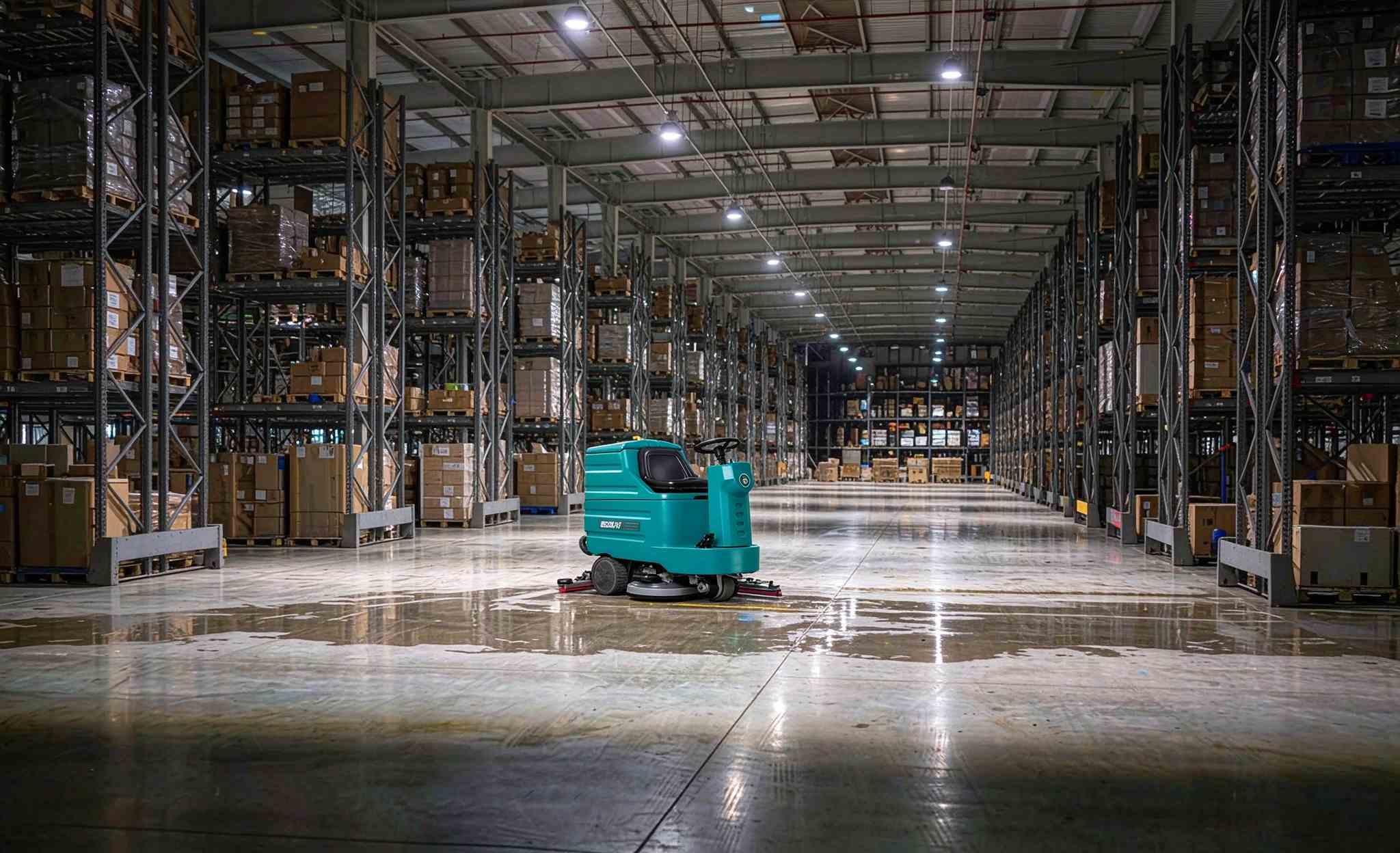
The machine the rating was written for: long, open, unobstructed aisles. Every departure from this scene — a turn, an island, a refill run — moves your achieved coverage away from the number on the sheet.
Cleaning width and scrub deck geometry
Cleaning width is the swath the brushes cover in one pass — 860 mm on the A7-class deck of a dual-brush ride-on floor scrubber, 1,060 mm on the A17-class ultra-large dual-brush ride-on floor scrubber. But width does not translate one-to-one into productivity: it halves the number of passes, and passes were never the whole job.
Three geometry facts do most of the work. Deck width is not machine width: the 860 mm deck rides on a 90 cm chassis, the 1,060 mm deck on a 140 cm chassis — and doorways, lifts and ramps are measured against the chassis. The squeegee must be wider than the deck: 1,100 mm of suction width behind the 860 mm deck, 1,400 mm behind the 1,060 mm. And passes need overlap, because nobody drives a perfect 860 mm grid.
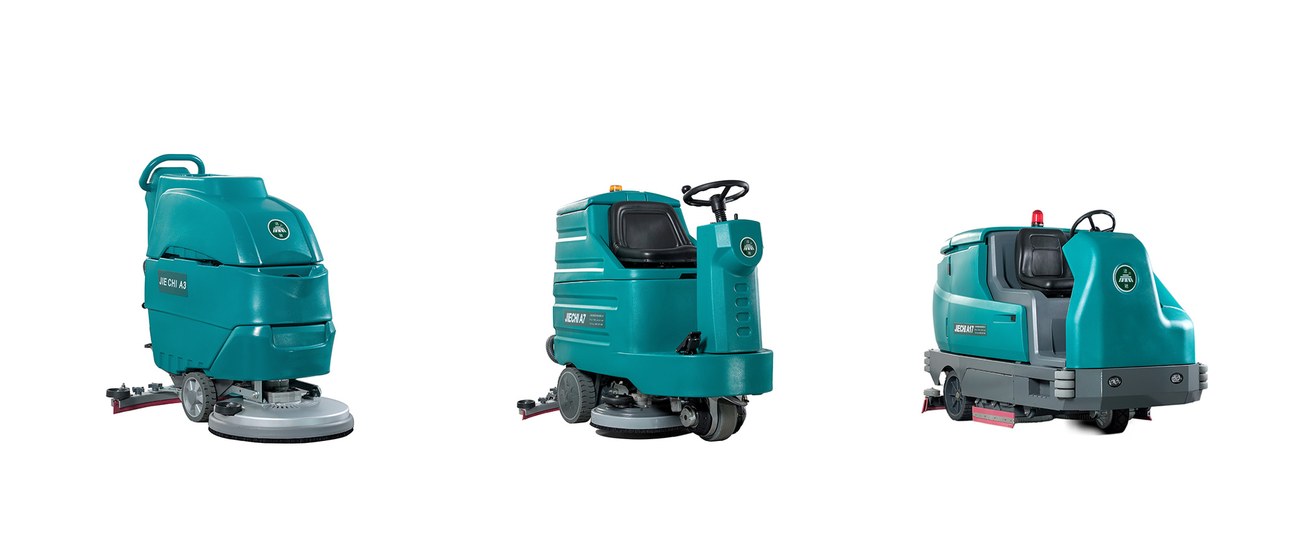
So measure your narrowest pinch point before your floor area. If the tightest aisle or lift threshold cannot take a 90 cm chassis, you are shopping for a 530 mm walk-behind floor scrubber instead. If the aisles are merely short, the wide deck spends its life turning — and turning is where the rating starts to leak.
Theoretical vs achieved coverage rate
The rated m²/h figure is a theoretical maximum, and the datasheet's own numbers prove it. Theoretical coverage = cleaning width × travel speed. Rearranging the A7's rating: 5,500 m²/h ÷ 0.86 m ≈ 6,400 m/h — about 6.4 km/h, sustained, in perfectly straight lines. The A17's 8,600 m²/h ÷ 1.06 m ≈ 8,100 m/h. Both assume no lifted brushes, no corners, no emptying tanks.
The two formulas to keep:
Theoretical coverage (m²/h) = cleaning width (m) × travel speed (m/h)
Achieved coverage = theoretical coverage × utilization — the fraction of the hour you are actually scrubbing, after turns, obstacles, refills and dumping.
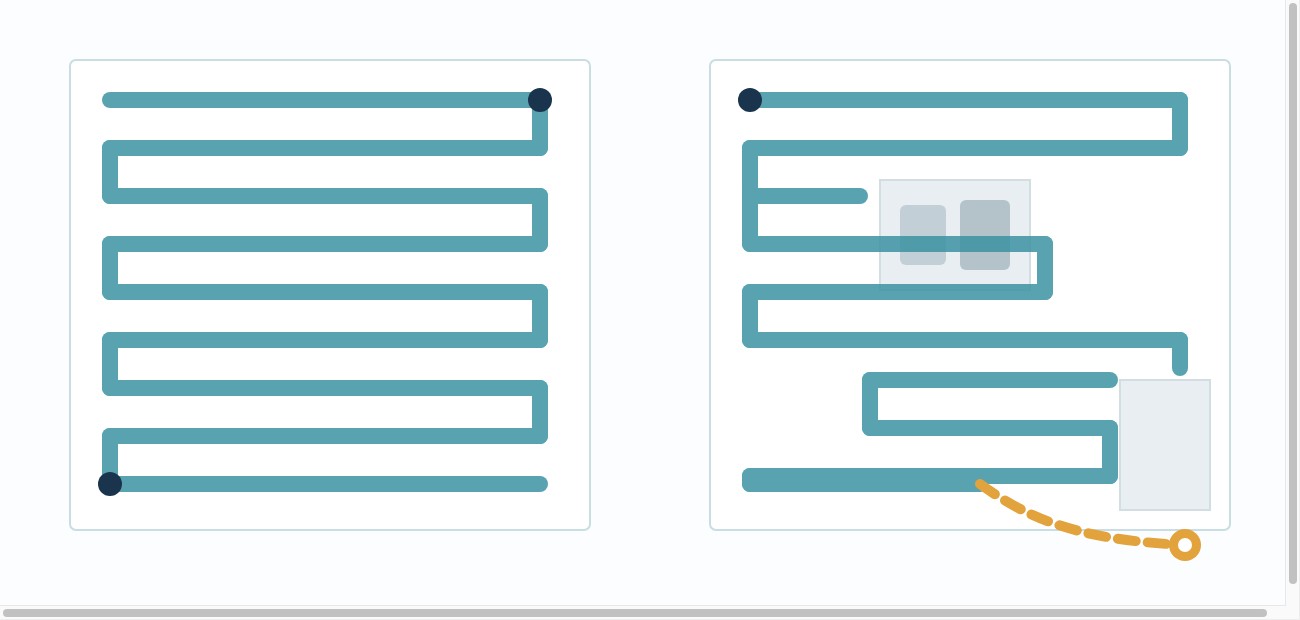
Utilization belongs to your building, so nobody publishes it. Measure it: walk one shift, divide the area finished by the scrubbing minutes spent. One honesty check cuts both ways — a small utilization penalty on a big deck can still beat perfect utilization on a small one.
Brush pressure and down pressure per centimetre
Coverage answers "how fast can you go?" Pressure answers "what does one pass leave behind?" Down pressure — the force pressing the brush into the floor, ideally per centimetre of brush edge — decides whether heavy soiling comes off in one pass or needs a second, which makes it the specification that converts most directly into labor hours.
The gap is plain: neither product page publishes a down pressure figure. What they publish is brush motor power — 560 W × 2 on the A7-class deck, 800 W × 2 on the A17-class — which is a proxy, not a substitute: it shows the machine can sustain agitation, not how hard the brush presses onto your finish.
Tank capacity and refill intervals
Tank capacity is where the coverage rating meets the plumbing. Every litre laid down comes back as recovery water, hence two tanks — 140 L / 150 L on the A7-class, 300 L / 350 L on the A17-class. The refill interval formula is simple:
Refill interval (h) = usable solution (L) ÷ solution flow (L/h) — and because flow depends on your pressure setting, soil load and floor porosity, it is a number you measure on your own floor, not one the datasheet prints.
Two structural points follow. Wider decks drink faster at the same soil load — the A17's 300 L tank buys less than double the A7's interval because its deck is wider. And the interval that matters is door-to-door time: a 140 L tank next to the tap beats a 300 L tank three floors down. Map your water points first, then log every stop for one week — if water breaks your shift twice, the tank or the route must change.
Battery runtime against shift length
The last resource is the battery. The pages publish voltage and capacity: 24 V / 200 Ah on the A7, 36 V / 460 Ah on the A17. Multiply to get stored energy — about 4.8 kWh and about 16.6 kWh. That is datasheet arithmetic, not a runtime promise. Runtime is:
Runtime (h) = usable battery energy (kWh) ÷ average power draw (kW) — where average draw combines traction, brush and suction motors under your settings and your floor. No page publishes a combined draw figure, so this input is yours to measure.
Size it honestly: list every load — traction (800 W on the A7-class; 1,500 W appears only in the A17's headline block), brush motors (560 W × 2 and 800 W × 2), suction and lifting motors — and accept that the sum runs at full tilt only for fractions of a cycle. Average draw depends on brush pressure and slope, so measure one real shift, then match it to your shift length.
Common Questions
What does a 5,500 m²/h rating on a floor scrubber actually mean?
It is a theoretical maximum: cleaning width times flat-out speed. On an 860 mm deck it works out to about 6.4 km/h of continuous straight driving with no stops. Your achieved rate will be lower, so treat the rating as a size indicator, not a shift plan.
Is a wider cleaning width always better?
No. Width only pays on open floor; in short aisles a wide deck spends its life turning, and the chassis carrying it may not fit your doors, lifts or ramps. Match width to your open area and your narrowest pinch point, not to the biggest number on the page.
How do I work out how long a tank lasts?
Refill interval = usable solution ÷ your solution flow per hour. Tank size is on the datasheet — 140 L on the A7-class, 300 L on the A17-class — but flow depends on your pressure setting, soil and floor, so measure it during one supervised shift.
How long does the battery run on one charge?
Runtime = usable energy ÷ average draw. The datasheets give stored energy — about 4.8 kWh for the 24 V / 200 Ah A7-class, about 16.6 kWh for the 36 V / 460 Ah A17-class — but no draw figure is published, so runtime must be measured on your floor.
Which specification should I check first?
The one behind your binding constraint. Tight access: chassis width against your pinch points. Shifts running out of time: width and achieved coverage. Shifts full of stops: tanks and water points. The spec sheet ranks its numbers for the factory; rank them for your building.
Conclusion
A floor scrubber specification sheet is a set of inputs, and your building supplies the rest. Width buys passes, the rating is a theoretical pace, pressure decides what one pass leaves, tanks set the refill rhythm, and battery energy sets the charging rhythm. Translate every number through the five formulas, measure the inputs the datasheet leaves out, and anchor the datasheet table — not the headline — in your quote. Then the spec sheet becomes what it should have been all along: a forecast of your own shift.
Send us your floor dimensions, shift length and pinch points — we will reply with the coverage and runtime math written out for your site.
Email: kliu@jiechi.com | Phone / WhatsApp: +1 240 314 9021
Contact us